How to Journal Forex Trades for Consistent Success
Stop repeating mistakes. Learn how to journal forex trades with our pro framework to analyze your edge, improve discipline, and achieve consistent gains.
By FXMARE Editorial · · 13 min read
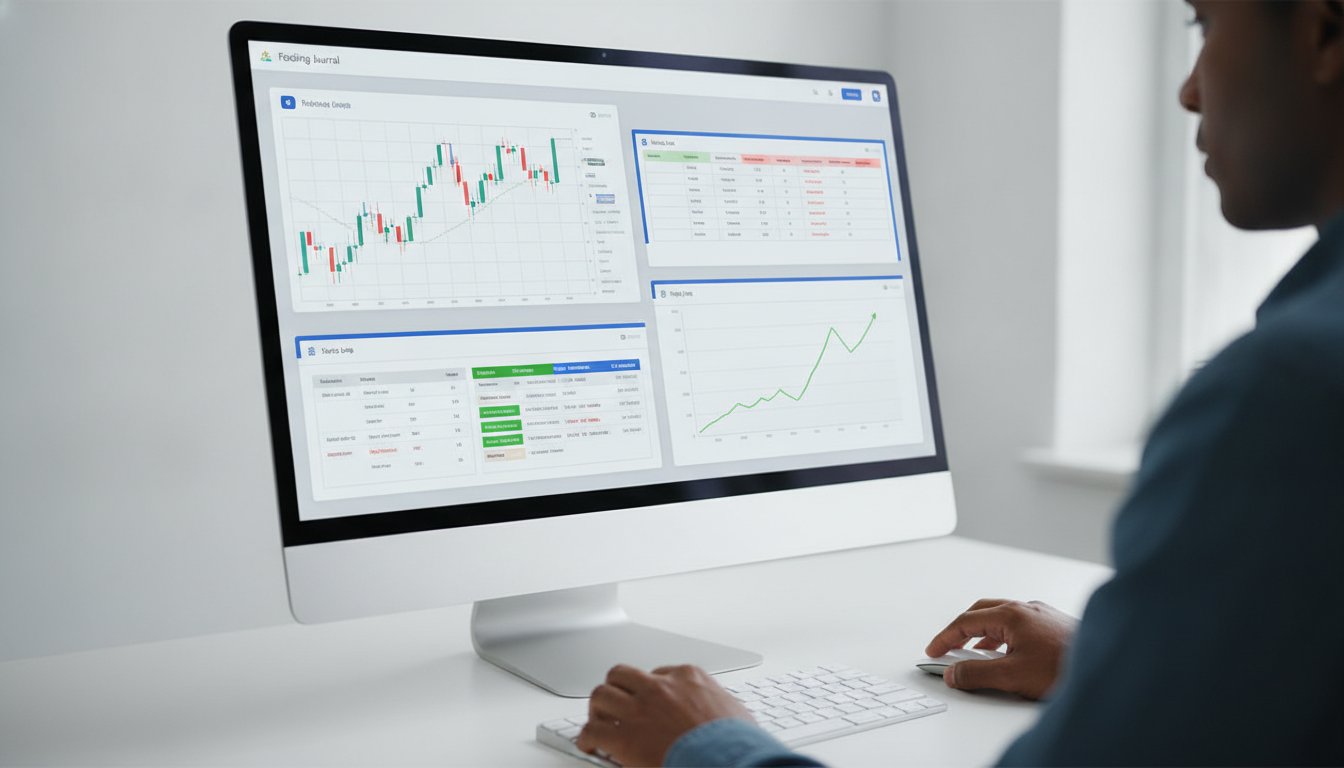
Most traders treat their history like a graveyard of mistakes rather than a blueprint for growth. You've likely felt the frustration of repeating the same emotional entry. You've probably wrestled with a clunky spreadsheet that feels more like a chore than a tool. It's exhausting to trade without knowing which strategies actually work. Learning how to journal forex trades is the only way to bridge the gap between gambling and professional speculation.
We understand that manual entry errors and spreadsheet fatigue are real barriers to your success. This guide provides the exact framework professional traders use to record, analyze, and optimize every position for long-term profitability. You'll move past the noise of random results. You'll build data-backed confidence in your edge. We will walk through building a clear journaling routine, improving your discipline, and using zero-friction tools to streamline your workflow. It's time to stop guessing. Start scaling with a system designed for active use. We'll explore how to transform your raw data into a reliable roadmap for consistent gains.
Key Takeaways
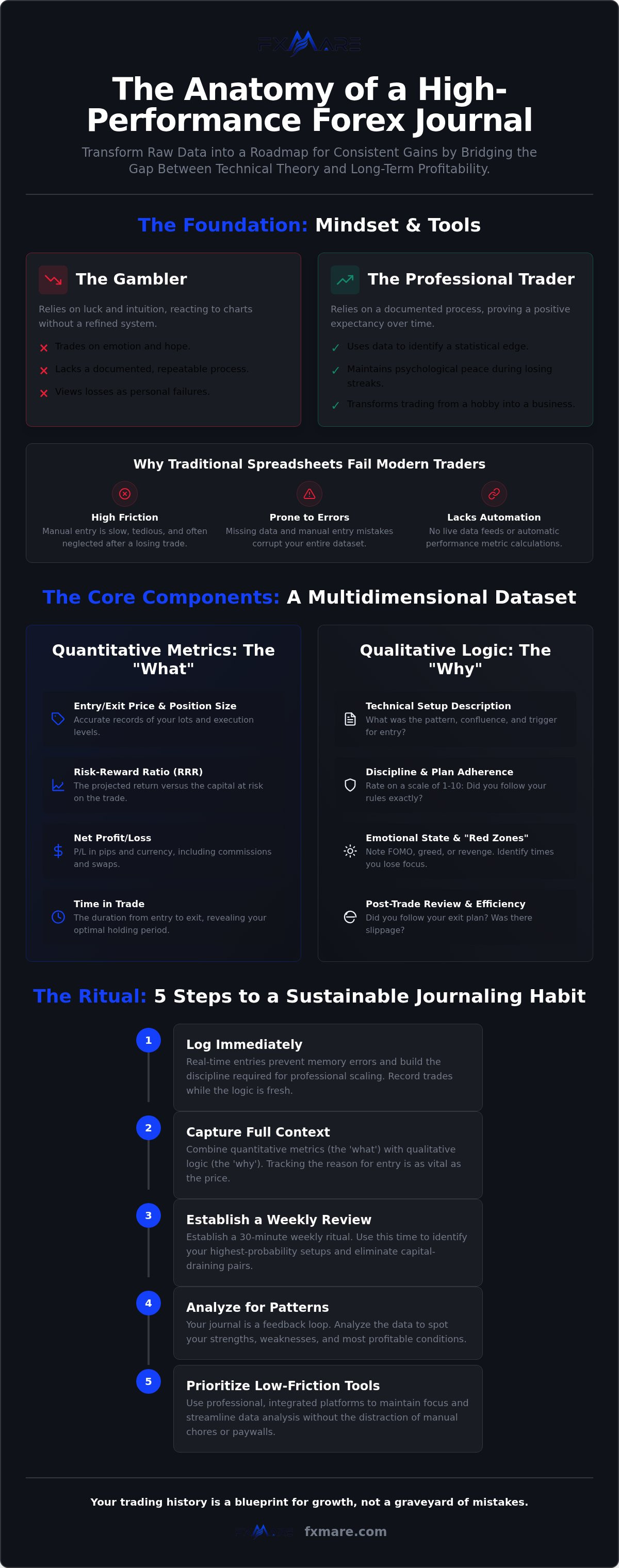
- Transform your trading history into a functional feedback loop. A structured log bridges the gap between technical theory and long-term profitability.
- Combine quantitative metrics with qualitative logic. Tracking the "why" behind your entries is as vital as recording the entry price and lot size.
- Establish a 30-minute weekly review ritual. Use this time to identify your highest-probability setups and eliminate the pairs that drain your capital.
- Master how to journal forex trades by logging every position immediately. Real-time entries prevent memory errors and build the discipline required for professional scaling.
- Prioritize low-friction tools. Use professional, ad-free platforms to maintain focus and streamline your data analysis without the distraction of paywalls.
Why a Forex Trading Journal is Your Most Important Tool
A trading journal is a structured record of your activity and the specific logic behind every decision. It isn't just a ledger. It's a professional feedback loop. This loop bridges the gap between technical theory and actual profit. Without a record, your progress is accidental. You're reacting to the charts instead of refining a system.
Objectivity is the goal. The human brain is wired for bias. We forget mistakes. We inflate successes. A journal provides raw data. It allows you to bypass emotional traps by focusing on hard numbers. You can't scale what you don't measure. Learning how to journal forex trades allows you to identify your edge with mathematical certainty. It transforms trading from a hobby into a business.
The Difference Between a Trader and a Gambler
Gamblers rely on luck. They trade on intuition. They hope for the best. Traders rely on a documented, repeatable process. A journal is the proof that your strategy has a positive expectancy. It shows that over 100 trades, your system wins. This provides psychological peace. When you know your win rate, a losing streak doesn't cause panic. It’s just a statistical reality.
Why Spreadsheets Often Fail Modern Traders
Many traders start with spreadsheets. These files often become a source of friction. Manual entry is slow. It's difficult to open a laptop after a losing trade. This leads to missing data. It leads to manual entry errors. Traditional spreadsheets lack real-time integration. You spend too much time on manual calculations. Understanding how to journal forex trades requires a faster, more integrated approach.
- High friction: Manual entry feels like a chore.
- Lack of context: Hard to record emotional states effectively.
- No automation: Missing live data feeds and performance metrics.
A modern, cloud-based workflow is essential for efficiency. You need a tool that syncs across devices. Log trades while the logic is fresh. Efficiency removes the barriers to discipline. It ensures your data is accurate. It makes it accessible. Your data is ready for analysis at any moment.
The Core Components of a High-Performance Trade Log
A high-performance log is more than a list of wins and losses. It's a multidimensional dataset. To master how to journal forex trades, you must separate the "what" from the "why." Quantitative data tracks your math. Qualitative data tracks your mind. Both are required to build a scalable edge. If you only record the profit, you're missing the patterns that lead to it.
Pre-trade context is the foundation. You need to document market conditions, technical setup descriptions, and pending news events. Post-trade reviews are equally critical. You should analyze slippage and exit efficiency. Did you follow your plan, or did the market's volatility force a premature exit? Recording these details turns a simple list into a professional diagnostic tool.
Essential Quantitative Metrics
These are the hard numbers. They tell you if your strategy is mathematically sound. Every entry must include the following data points:
- Entry/Exit Price and Position Size: Accurate records of your lots and execution levels.
- Risk-Reward Ratio (RRR): The projected return versus the amount at risk.
- Net Profit/Loss: P/L in both pips and currency, net of commissions and swaps.
- Time in Trade: The duration from open to close.
Tracking time in trade is particularly revealing. You might discover you're a profitable scalper but a losing swing trader. Net profit must account for commissions and swaps. Ignoring these costs can turn a winning strategy into a losing one over time. Use a professional forex calculator to ensure your position sizing and risk metrics are precise before you pull the trigger.
Quantifying Your Psychological State
This is where most traders fail. They ignore the human element. You should rate your discipline on a scale of 1 to 10 for every setup. Did you follow your rules? Or did FOMO drive the entry? Recording emotions like greed or revenge trading helps you identify your "Red Zones."
Red Zones are specific times of day or emotional states where you consistently lose money. Perhaps you're highly disciplined during the London session but lose focus during the New York afternoon. Quantifying these "soft" insights allows you to create rules that protect your capital. Knowing how to journal forex trades effectively means acknowledging your biases. Once they're documented, they're no longer invisible. You can't fix a problem you haven't measured. Professional journaling brings these hidden leaks to the surface so you can plug them.
How to Analyze Your Data to Spot Profitable Patterns
Data collection is only the first step. Analysis is where you find the money. Most traders fail because they treat their log as a diary rather than a diagnostic tool. Analysis isn't a passive activity. It's a proactive hunt for efficiency. You're looking for the 20% of your actions that generate 80% of your results. This requires a structured approach to your historical data.
The 30-minute weekly review is your most profitable ritual. Conduct this every Sunday before the market opens. Filter your trades by asset class, session, and setup type. You might discover you have a 70% win rate on EUR/USD during the London session but lose consistently on USD/JPY during New York. These are your "Best Friend" setups. Learning how to journal forex trades effectively means identifying these high-probability windows and focusing your capital there.
Eliminating leaks is just as vital. Most traders have one recurring error that eats the majority of their profit. It could be over-leveraging during high-impact news or moving stop losses to breakeven too early. Your equity curve will reveal these cycles. It shows the truth about your drawdown and recovery. If your curve is jagged, your risk management is inconsistent. If it's flat, your edge is dull. Use these insights to sharpen your strategy before placing the next order.
The Power of Strategy Tagging
Use specific tags to categorize your trades. Labels like #Breakout, #MeanReversion, or #TrendFollowing allow for direct comparison. You'll quickly see which technical indicators provide a genuine signal and which are just noise. If your "Mean Reversion" trades have a negative expectancy over 50 samples, stop taking them. Focus your capital on the setups that your journal proves are profitable. This data-backed confidence is what allows you to scale your position sizes safely.
Correcting Behavioral Errors
Your journal exposes the gap between your plan and your actions. Look for "Ghost Trades"-positions you took that weren't in your written strategy. These are often driven by boredom or impulse. Analyze your "Early Exits" as well. Are you cutting winners short out of fear? If your data shows that trades hit your original take-profit 65% of the time after you closed them early, you're leaving money on the table. Use these findings to build a customized "Do Not Trade" list. This list should include emotional states or market conditions where your performance historically drops. Professionalism is about knowing when to stay out of the market as much as when to enter it.
Building a Sustainable Journaling Habit: 5 Practical Steps
Consistency is the barrier between a hobbyist and a professional. Most traders quit their log after a losing week because the friction of entry outweighs the perceived benefit. Building a system for how to journal forex trades requires more than a notebook. It requires a workflow that survives your worst trading days. Follow these five steps to ensure your journal becomes a permanent part of your edge.
- Step 1: Choose a low-friction platform. Use a tool that syncs across your devices. If you have to fight your software, you'll stop using it.
- Step 2: Log the trade immediately. Memory is a liar. Record your logic the moment you execute the order. Waiting until the end of the day allows emotional bias to distort your reasoning.
- Step 3: Capture screenshots. Save the chart at entry and exit. Visual data reveals price action nuances that numbers alone cannot capture.
- Step 4: Schedule a weekend review. This is your non-negotiable strategy meeting. Spend 30 minutes every Saturday analyzing the week's performance.
- Step 5: Reward the process. Discipline is a muscle. Value the act of logging a loss correctly as much as you value a profitable trade.
Integrating the Journal into Your Trading Routine
Professionalism starts before the first candle forms. Use a "Pre-Flight" checklist. Read your entries from the previous session to avoid repeating yesterday's mistakes. When you close a position, use a "Post-Flight" log. This closes the emotional loop. Write one short sentence defining the trade setup. If you can't describe the logic in ten words, you shouldn't be in the trade. This clarity ensures you only risk capital on setups you fully understand.
Overcoming Journaling Fatigue
Friction is the enemy of data. Keep your entries minimalist to prevent mental overwhelm. Focus on the five most impactful data points first. You don't need a thousand metrics to start seeing patterns. Use a mobile app for logging trades while you're away from your workstation. A clean, uncluttered interface prevents the fatigue often associated with dense spreadsheets. If you want a professional tool designed for speed, start your free trading journal today. The FXMARE Android app offers a zero-friction experience with no ads or paywalls. It allows you to maintain your discipline whether you're at your desk or on the move. Efficiency is the key to longevity in this business.
FXMARE: Professional Journaling Without the Friction
Theory is useless without a tool that supports it. FXMARE provides a free trading journal designed specifically for professional utility. It removes the common digital barriers that hinder consistency. Understanding how to journal forex trades with speed is essential for long-term growth. There are no paywalls. There are no intrusive ads. This is a clean, understated workspace that respects your time. It functions as a reliable companion for your daily market activity.
Accessibility is a core requirement for modern traders. FXMARE uses cloud-based synchronization to ensure your data is available anywhere. You can log a position on your PC workstation and review the performance on your Android app during your commute. This seamless transition maintains your communication rhythm. It keeps your most critical data at the forefront. Learning how to journal forex trades effectively becomes significantly easier when the platform handles the technical heavy lifting for you.
The platform is part of an integrated ecosystem. Your journal works alongside live market data feeds and professional forex calculators. You can use the economic calendar to identify high-impact events before they occur. This integration ensures your trade log is always contextualized by real-world volatility. It turns your data into a high-tech utility rather than a static list of numbers.
Why FXMARE Beats Manual Spreadsheets
Spreadsheets are prone to human error. FXMARE automates your performance analytics to eliminate manual entry mistakes. It generates visual equity curves and drawdown reports automatically. This provides an immediate view of your strategy's health. The design is minimalist and functional. It mirrors a professional dashboard rather than a cluttered ledger. This speed allows for rapid information retrieval. You can scan your history in seconds to find the patterns that matter most.
Getting Started in Under 60 Seconds
Efficiency starts with the setup. You can create an account and begin tracking your trades in less than a minute. The process is streamlined to ensure you spend your time on analysis, not configuration. Use the platform’s economic calendar to filter out noise and focus on high-probability setups. This all-in-one approach provides the logic and data you need to scale. Start your free trading journal on FXMARE today and begin building your data-backed edge with a tool built for active use. Professional success requires professional tools. Stop fighting with clunky files and start using a workspace that works for you.
Mastering the Professional Feedback Loop
Trading success is a byproduct of discipline and data. You've learned that a high-performance log requires both quantitative metrics and qualitative insights to be effective. By establishing a weekly review ritual, you can identify the specific pairs and sessions that provide your true edge. Learning how to journal forex trades is the final step in moving from retail gambling to professional speculation. It turns your history into a roadmap for future profit.
Your tools should support your growth rather than hinder it. Stop fighting with manual spreadsheets and entry errors. Use a platform built for speed and clarity. Start Your Free Trading Journal on FXMARE to access a professional, ad-light interface designed for active use. Our system is free forever with no hidden paywalls. It includes real-time global market data integration to keep your records accurate and context-rich. Build your consistency with a minimalist workspace that respects your focus. The market is always moving. Start measuring what matters today.
Frequently Asked Questions
What is the best way to journal forex trades for free?
The best way to journal forex trades for free is to use a platform that prioritizes utility over marketing. FXMARE offers a zero-friction, ad-light experience that includes a mobile app for Android. This allows you to record trades without paywalls or hidden costs. Digital tools are more reliable than manual entry because they integrate with live market data and economic calendars. This setup ensures your records are accurate and professional from day one.
Should I use a physical notebook or a digital trading journal?
Digital journals are the professional standard. While physical notebooks help with long-form reflections, they lack the analytical power needed to scale. A digital tool allows for strategy tagging, automated equity curves, and rapid search. You can't filter a notebook to see your win rate on specific pairs during the London session. Cloud-based syncing ensures your data is always accessible, making it the more functional choice for modern traders.
What are the most important metrics to track in a forex journal?
You should prioritize metrics that define your mathematical edge. Track entry and exit prices, position sizes, and risk-reward ratios for every trade. It's also vital to include commissions and swaps to understand your net P/L. Beyond numbers, record the technical setup and your emotional discipline rating. Mastering how to journal forex trades involves linking these hard numbers with soft insights to find the 20% of actions generating your profit.
How much time does it take to maintain a trading journal?
Maintaining a journal takes approximately two minutes per entry if you use a streamlined digital interface. The goal is speed and accuracy. Log the trade the moment you execute the order to avoid memory bias. Additionally, schedule a 30-minute review every weekend to analyze your data. This small commitment creates a professional feedback loop that prevents repeating the same expensive mistakes. Efficiency in the tools you choose makes this habit sustainable.
Can a trading journal really help me master my emotions?
A journal is an essential tool for emotional regulation. It forces you to document the why behind every entry, exposing impulsive behavior like FOMO or revenge trading. By rating your discipline for each setup, you create an objective record of your psychological state. This data allows you to identify specific triggers that lead to losses. Over time, this awareness helps you build the mental fortitude required to follow your plan consistently.
How often should I review my trading journal entries?
Review your entries daily and weekly. A quick Pre-Flight check before your session keeps recent lessons fresh in your mind. The weekend review is for deeper analysis, such as spotting profitable patterns or identifying leaks in your strategy. Monthly reviews help you understand your equity curve and drawdown cycles. Regular reviews transform your log from a simple list into a powerful diagnostic tool for long-term performance optimization.
What should I do if I forget to log a trade?
Log the trade immediately once you realize the omission. Use your broker's execution history to retrieve the entry price, exit price, and exact times. Label it as a Late Entry in your journal. Use the comment section to analyze why you missed the entry. Often, forgotten logs correlate with impulsive or emotional trades. Documenting these lapses is critical for maintaining the integrity of your data and your personal discipline.
Is it worth journaling demo account trades?
Journaling demo trades is vital for building a professional routine. It allows you to verify a strategy's expectancy and practice how to journal forex trades without financial risk. If you can't maintain a log on demo, you'll struggle with consistency on a live account. Use this period to refine your data-tracking workflow. Proving your edge in a simulated environment provides the data-backed confidence needed to transition to real capital successfully.
Educational content only. It is not investment advice. Trading leveraged products involves substantial risk.