Trading Psychology Journal Free: Master Your Emotions
Find the best trading psychology journal free of charge in 2026. Master your emotions, stop revenge trading.
By FXMARE Editorial · · 13 min read
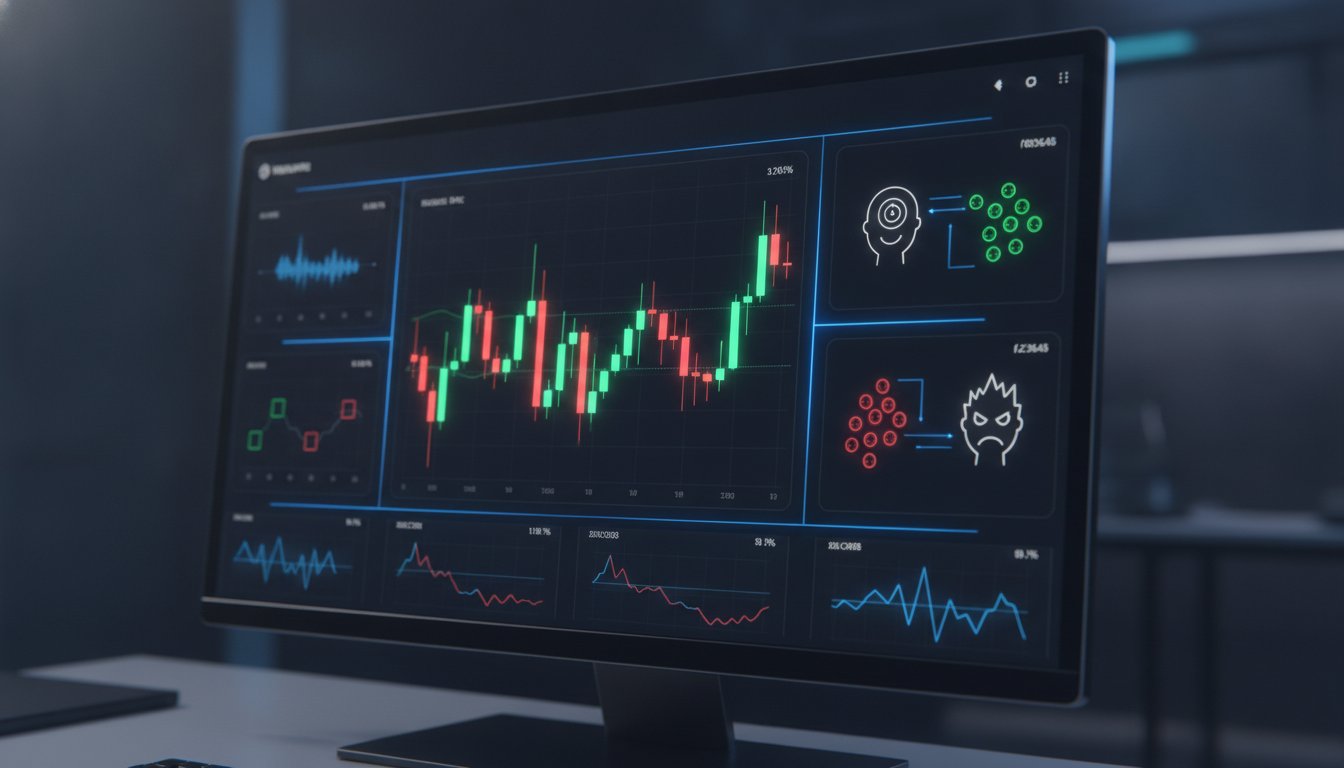
Your biggest trading loss wasn't caused by a bad strategy. It was a data entry error in your brain that you couldn't see. Most traders treat their emotions like weather. They think it's something that just happens to them while they watch the charts. But psychology is a measurable variable. Finding a trading psychology journal free of paywalls is the first step to tracking this data without adding financial stress.
You've likely felt the sting of a revenge trade or the fear of clicking "buy" on a valid setup. Research by Daniel Kahneman shows we feel the pain of a loss twice as intensely as the pleasure of a gain. It's frustrating to watch your edge disappear because of a split-second impulse. We agree that professional tools shouldn't come with a professional price tag. You deserve a clean way to audit your mental state without the friction of a subscription.
This article promises to help you quantify your emotional triggers and eliminate the cost of FOMO. We'll preview the best free journaling tools available in 2026. You'll learn how to integrate economic calendars with your reviews to spot news-based triggers. It's time to build a data-driven routine that protects your capital from your own impulses.
Key Takeaways
- Identify the "invisible tax" of FOMO and revenge trading to stop eroding your edge.
- Use a trading psychology journal free of paywalls to link specific market conditions to your emotional triggers.
- Transition from manual spreadsheets to automated digital tools to ensure psychological honesty and save time.
- Implement a two-phase audit system to set intentions before the market opens and tag emotions during execution.
- Leverage cloud-based utilities to build a disciplined routine without the burden of subscription fees.
Why Emotions Are Your Most Expensive Trading Cost
A trading strategy is a map. Execution is the journey. The gap between your plan and your actual trades is where profits disappear. This gap defines your trading psychology. You can have the best indicators in the world, but if you can't click the button when the setup appears, the strategy is worthless.
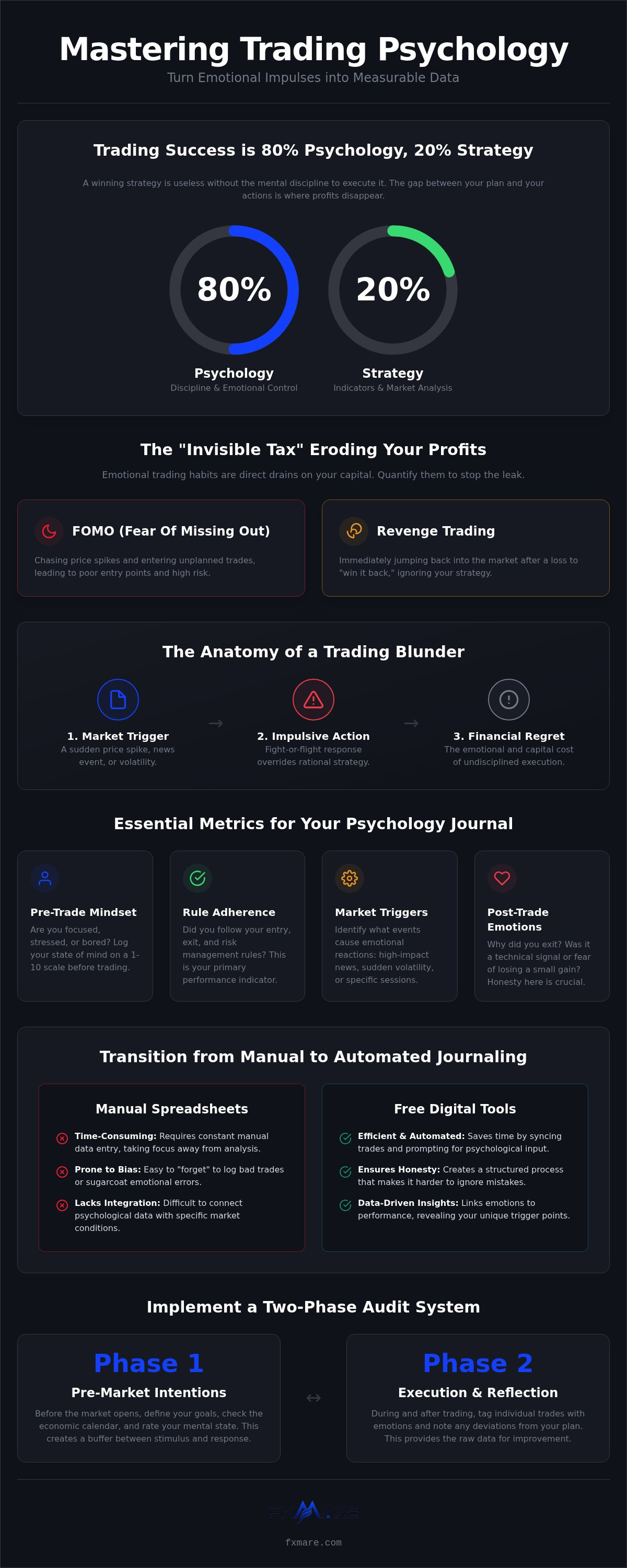
Strategy is only 20% of the success equation. The remaining 80% is the mental discipline to follow it. Most traders pay an "Invisible Tax" every single day. This tax comes in the form of FOMO and revenge trading. These aren't just personality quirks. They are direct drains on your capital. To stop the bleed, you must move from qualitative feelings to quantitative behavioral data. Using a trading psychology journal free of hidden costs helps you treat your mind like a performance metric rather than a mystery.
This shift from intuition to logic is central to modern market analysis. This Behavioral Finance Overview explains how cognitive biases often override rational decision-making in financial markets. Understanding these biases is the first step toward neutralizing them. When you quantify your behavior, you turn your weaknesses into data points.
The Anatomy of a Trading Blunder
Most mistakes follow a predictable "trigger-action-regret" cycle. It starts with a market event, like a sudden price spike. This triggers a biological response. Your brain releases cortisol and adrenaline. In high-stakes environments, these chemicals activate your fight-or-flight system. You aren't thinking about probabilities anymore; you're reacting to perceived threats or rewards. The result is usually an impulsive action followed by immediate regret. Your brain is wired for survival, not for the counterintuitive world of risk management.
Quantifying the Cost of Discipline
You can't manage what you don't measure. Start by calculating your "FOMO Gap." This is the dollar difference between what your strategy should have made and what you actually took home. Tracking these mistakes reveals your true profit potential. "Equity Leak" is the cost of emotional errors. When you see the cumulative price of your impatience, discipline becomes a financial necessity rather than a vague goal. A trading psychology journal free utility provides the framework to identify these leaks before they blow your account. It allows you to see exactly how much your emotions are costing you in pips and dollars.
Essential Metrics for Your Free Psychology Journal
Data collection is the only way to bridge the gap between your strategy and your execution. A trading psychology journal free of friction allows you to document the internal variables that P&L ignores. Start with your pre-trade mindset. Are you entering because a setup exists, or because you're bored? Tracking your state before the first click creates a buffer between stimulus and response. This buffer is where your edge lives.
Rule adherence is your primary performance indicator. It tracks how often you follow your guardrails. A trade that hits your profit target but broke your entry rules is a failure of discipline. Post-trade reflection then captures the "why" behind the exit. Did you close because the trend ended, or because you were scared to lose a small gain? Scientists studying the neuroscience of trading decisions have found that our brains process financial losses in the same regions as physical pain. This makes "holding the winner" a biological challenge that requires data-driven awareness to overcome.
Emotional State Variables
The "Big Four" emotions, Fear, Greed, Revenge, and Impatience, are the most common culprits for account blowouts. Physical triggers like fatigue or external stress also lower your cognitive threshold for making bad decisions. Use a 1-10 scale to rate your "State of Mind" before every session. If you consistently lose money when your stress level is above a 7, you've found a data-backed reason to stay on the sidelines. Logging these variables in a free trading journal helps you identify these patterns early.
Contextual Market Triggers
Emotions are often reactions to specific market environments. High-impact news events are frequent emotional catalysts. Sudden volatility can trigger a panic exit even if your stop loss is safe. Track your performance by trading session to see if the New York open triggers your impatience more than the London session. Linking your emotions to market context allows you to build a personalized "danger zone" map. Building a trading psychology journal free of unnecessary complexity is the most efficient way to master these triggers.
Digital Journal vs. Spreadsheets: Finding the Best Free Option
Excel is the default choice for many. It's free and familiar. But spreadsheets have a hidden cost. They require manual maintenance that most traders eventually abandon. Manual entry creates a massive barrier to entry every time you close a trade. In a fast-moving market, you don't have ten minutes to format cells. You need speed and functional efficiency. Moving to a dedicated digital workspace removes this friction.
The Failure of Manual Logging
Traders often quit journaling during a losing streak. It's a psychological defense mechanism. Typing out a loss feels like losing the money a second time. Manual logging also invites hindsight bias. You might find yourself "adjusting" the reason for entry to make it look like you followed your plan. Automation ends this friction. It forces you to confront the data exactly as it happened. When the system logs the trade, you can't hide from the results.
Automated data sync is the foundation of psychological honesty. When your journal pulls data directly from the broker, you can't ignore the trades that hurt. This creates a complete, unedited record. A trading psychology journal free of manual hurdles ensures you actually stick to the routine. It transforms journaling from a chore into a high-tech utility.
Features to Look for in a Free Tool
Not all free tools are equal. Many platforms offer a "free" version that caps your trade history or hides advanced metrics behind a paywall. This limits your ability to see the big picture. You need years of data to spot long-term behavioral patterns. Look for a solution that offers unlimited trade history without hidden fees.
Cloud accessibility is another non-negotiable. Your journal should live on your desktop and your phone. Mobile app availability allows for instant post-trade notes. If you wait three hours to record how you felt during a panic exit, the memory is already distorted. You need to capture the raw emotion in real-time. Integration with real-time economic calendars is also vital. It allows you to see if your emotional triggers coincide with high-impact news releases. This level of detail is difficult to maintain in a standard spreadsheet.
Finally, prioritize security. Even with a trading psychology journal free utility, your data privacy is paramount. Ensure the platform uses modern encryption to protect your execution data. A clean, functional interface that respects your time and your data is the hallmark of a professional tool designed for active use.
Step-by-Step: How to Audit Your Trading Mindset
Auditing your mindset is a four-phase process. It transforms abstract feelings into actionable data. You don't need a complex AI coach to find your flaws. You just need a consistent routine and a trading psychology journal free of friction. This structure ensures you capture the raw truth of your execution before your brain has time to rationalize your mistakes.
Building Your Daily Routine
Consistency starts before the market opens. Phase 1 is your Pre-Market Prep. Spend five minutes on a mental clarity checklist. Ask yourself if you're chasing a recovery or following a setup. Review the integrated economic calendar to anticipate high-volatility stress points. Knowing a news release is coming allows you to set a psychological intention to stay flat or reduce risk. This prevents reactive decision-making when the candles start moving fast.
Phase 2 happens during the Execution Phase. Speed is critical here. Use voice-to-text features on your mobile app for rapid emotional logging. If you feel your heart rate spike as you enter, record it immediately. Capturing these physical cues in real-time provides a level of honesty that hindsight can't replicate. Low-friction logging is the only way to ensure you actually document the heat of the moment without interrupting your focus on the charts.
Spotting the Patterns That Kill Accounts
Reviewing your data allows you to see the "Tuesday Tumble" or other time-based weaknesses. Phase 3 is the End-of-Day Review. You might find that your discipline erodes after 2:00 PM or on specific days of the week. Look for correlations between your emotional tags and your P&L. If every "Greed" tag results in a blown stop, the data is telling you to tighten your exit rules. This turns a vague feeling of "I need to be more disciplined" into a specific instruction to stop trading at a certain time.
Phase 4 is the Weekly Audit. This is where you adjust your strategy. Pay close attention to position sizes. Oversize positions are often a symptom of underlying emotional stress. The Revenge Trade is a data-identifiable event where a larger-than-average position is opened immediately following a loss, regardless of strategy validity. Identifying these spikes in your trading psychology journal free history allows you to create hard rules against immediate re-entry. To start auditing your execution with professional-grade tools, access your free trading journal today.
FXMARE: The Ultimate Free Tool for Disciplined Traders
Transparency is our foundation. Many platforms lure you in with a basic version only to lock critical features behind a paywall. FXMARE operates differently. We offer a 100% free, cloud-based utility supported by a transparent affiliate model. This ensures you never face a subscription fee or a hidden cost. You keep your capital for trading while accessing professional-grade analytics.
The FXMARE Journal is a trading psychology journal free of digital barriers. It's built for functional efficiency. You won't find high-pressure sales tactics or cluttered layouts here. Instead, you get a streamlined dashboard that prioritizes your data. It feels like a professional tool because it was designed for active, daily use by people who understand the market's pace.
A Zero-Friction Journaling Experience
Focus is a trader's most valuable asset. Our interface is ad-light and distraction-free. This allows you to stay in the zone while documenting your execution. Your data stays organized and accessible across all your devices. Whether you're at your desk or using the FXMARE Android app, your mindset data remains in sync. This mobile freedom is essential for capturing raw emotional notes immediately after a trade closes. You can log your thoughts while the adrenaline is still fresh, ensuring total psychological honesty.
Beyond the Journal: The Market Edge
A journal alone isn't enough to master the markets. You need a complete ecosystem. Our dashboard integrates live market data feeds, economic calendars, and Forex calculators in one place. You can use live heatmaps to confirm if your bias aligns with real-time market sentiment. This helps you spot when you're fighting the trend due to emotional stubbornness. It provides a logical check against the "invisible tax" of biased decision-making.
We also provide comprehensive broker reviews and comparisons. This helps you find reliable execution partners who won't hinder your performance with poor fills or high slippage. Every tool we provide is designed to remove friction from your workflow. By combining behavioral data with technical utilities, you build a disciplined routine that protects your P&L. It's time to stop guessing and start quantifying your edge. Start your free trading journal on FXMARE today and take control of your execution.
Take Control of Your Trading Mindset Today
Mastering your emotions is the final frontier of profitable trading. You've learned how emotional triggers like FOMO and revenge trading act as an invisible tax on your capital. Moving from manual spreadsheets to a dedicated digital workspace allows you to quantify these errors and stop the equity leak. By integrating real-time market data with your psychological tags, you turn behavioral patterns into actionable insights. It's about building a routine that respects your time and your intelligence.
Finding a trading psychology journal free of paywalls is no longer a challenge; it's a requirement for a disciplined routine. A professional tool should enable your success rather than act as a gatekeeper. You can now track your execution with real-time data for 5+ asset classes and use a professional-grade mobile app for journaling on the go. There are no hidden fees or subscription barriers to navigate.
Access the 100% Free FXMARE Trading Journal and start auditing your execution with precision today. Your most disciplined year starts with the next trade you log. Stay focused, stay data-driven, and keep your edge protected.
Frequently Asked Questions
Is there a truly free trading psychology journal available?
Yes, FXMARE provides a 100% free trading journal with no hidden paywalls or subscription tiers. Unlike many tools that limit your trade history, this platform offers unlimited journaling and real-time data for various asset classes. We monetize through broker referrals and sponsored placements. This allows us to keep the core features free for all active traders. Finding a trading psychology journal free of hidden costs shouldn't be a struggle.
How do I start a trading journal for psychology without using Excel?
You can start by using a cloud-based utility like the FXMARE journal. This removes the friction of manual formatting and broken formulas common in spreadsheets. Simply create an account, sync your trade data, and begin tagging your emotional states in real-time. It's a more efficient way to build a data-driven routine. It focuses on your execution rather than administrative tasks. This ensures you actually stick to the process.
What should I write in my trading psychology diary?
Focus on documenting your pre-trade mindset and the specific triggers that lead to execution errors. You should record your stress levels on a 1-10 scale and note any physical cues like a racing heart. Link these feelings to market conditions, such as high-impact news releases found on the economic calendar. This transforms qualitative feelings into quantitative behavioral data. It allows you to treat your mind like a performance metric.
Can a trading journal really stop me from revenge trading?
A journal acts as a psychological circuit breaker by forcing you to confront the data behind your impulses. When you quantify the Equity Leak caused by revenge trades, the financial cost becomes too high to ignore. Seeing a pattern of losses immediately following a stop-out creates a logical barrier. It helps you implement hard rules, such as a mandatory break after any losing trade. Data is the best cure for impulsive behavior.
Why is a digital journal better than a physical notebook for trading?
Digital journals offer speed and searchability that physical notebooks can't match. You can't run a data audit on a paper diary to find out which day of the week you're most impulsive. A digital trading psychology journal free of manual limitations allows you to filter by emotional tags and market conditions. This provides instant insights into your behavioral patterns across hundreds of trades. It requires zero manual calculation or complex formatting.
Do I need to pay for AI features to track my trading emotions?
No, you don't need expensive AI subscriptions to identify your mistakes. Most trading errors are caused by basic triggers like Fear or Greed. You can track these yourself using simple emotional tagging. While some platforms charge for automated analysis, a clean and functional free tool provides all the data you need. You are the best judge of your own mental state. You don't need an algorithm to tell you when you're tilted.
How often should I review my trading psychology journal?
Performing a brief review at the end of every trading session and a deeper audit every weekend is essential. The daily review captures raw emotions while they're fresh. The weekly audit helps you spot broader patterns, like correlations between news events and panic exits. Consistent review is the only way to turn your documented data into a permanent shift in behavior. It ensures you don't repeat the same expensive mistakes.
Is my trading data safe in a free online journal?
Security is a priority for professional-grade free tools. FXMARE uses modern encryption and secure cloud storage to protect your execution data and personal notes. We prioritize transparency and functional efficiency. This ensures your data is handled with the same care as a paid service. Always choose a reputable platform that respects your privacy. It should provide a clear explanation of how they maintain their free service through transparent business models.
Educational content only. It is not investment advice. Trading leveraged products involves substantial risk.